Contents
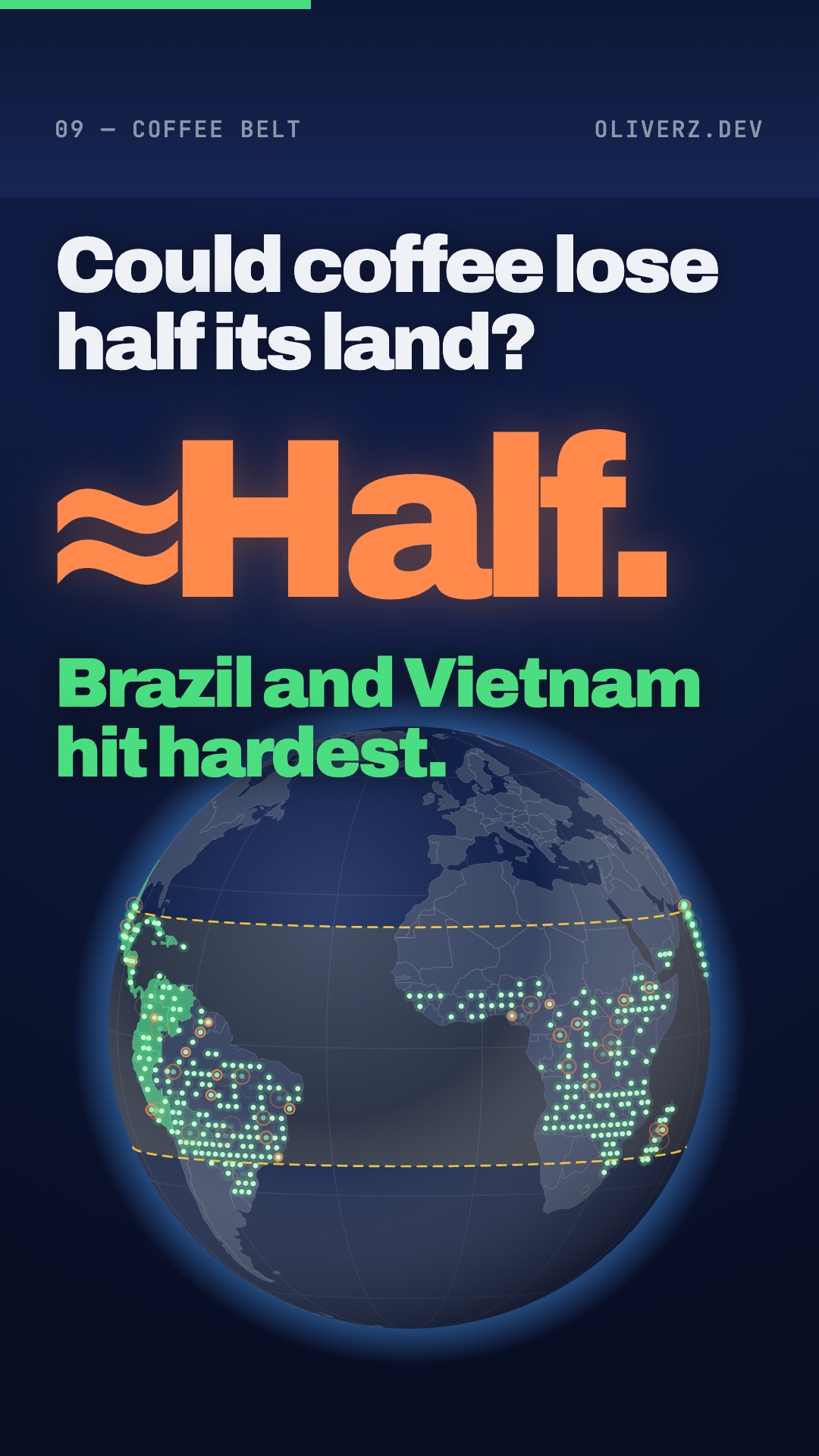
In short: coffee grows in one narrow belt around the Equator, between the Tropics of Cancer and Capricorn. Brazil and Vietnam grow more than half of the world's crop, and the European Union and the United States take about 60% of the world's bean imports. A study in Climatic Change projects climate change reducing the global area suitable for coffee by about half, with the biggest losses at low latitudes and in Brazil and Vietnam.
A record harvest
The USDA's Foreign Agricultural Service, in July 2026: "World coffee production for 2026/27 is forecast 10.8 million bags higher than the previous year to a record 189.7 million due to record output in Brazil, Ethiopia, Uganda, and Vietnam."
One thin belt
The National Coffee Association says coffee grows "In more than 40 countries, mostly in a narrow climactic zone along the Equator between the Tropics of Cancer and Capricorn (25°N to 30°S)!" ("climactic" is their spelling).
Two countries, more than half
The USDA: "Brazil accounts for nearly 40 percent of world production and exerts significant influence on global supplies and prices."
Its forecast for the season: "Brazil's combined Arabica and Robusta harvest is forecast to rise 8.9 million bags (60 kilograms) to a record 71.9 million in 2026/27 (July 2026 – June 2027)." And: "Vietnam production is forecast to increase 800,000 bags to a record 32.5 million due to expanding area and higher yields."
Our arithmetic: (71.9 + 32.5) ÷ 189.7 = 55.0%. Brazil and Vietnam together grow more than half of the world's coffee.
Most of it sails north
The USDA's import figures for 2025/26: "World bean imports are revised down 1.3 million bags to 118.6 million." Among them: "European Union is reduced 500,000 bags to 46.5 million on lower consumption", and "The United States is down 700,000 bags to 23.1 million on lower consumption."
Our arithmetic: (46.5 + 23.1) ÷ 118.6 = 58.7%, so the EU and the US take about 60% of the world's bean imports.
A warmer world: about half the land
A 2015 study by C. Bunn and colleagues, "A bitter cup: climate change profile of global production of Arabica and Robusta coffee" (Climatic Change), says in its abstract: "Climate change will reduce the global area suitable for coffee by about 50 % across emission scenarios."
That is a projection across scenarios, and the abstract gives no year for it, so the video says "could" and "about half".
Hardest near the Equator, and in Brazil and Vietnam
The same abstract: "Impacts are highest at low latitudes and low altitudes."
And on the two biggest growers: "The world's dominant production regions in Brazil and Vietnam may experience substantial reductions in area available for coffee."
Takeaway
- Your coffee comes from one thin belt, more than half of it from two countries.
- Most of it is drunk far to the north.
- A warmer world could cost that belt about half its suitable land, hitting the biggest growers hardest.
Sources
- USDA Foreign Agricultural Service, Coffee: World Markets and Trade, July 2026
- National Coffee Association, Coffee Regions of the World
- C. Bunn, P. Läderach, O. Ovalle Rivera, D. Kirschke, A bitter cup: climate change profile of global production of Arabica and Robusta coffee, Climatic Change 129(1), 89–101, March 2015
The video is animated with code and the script was written with AI assistance; every figure above is checked against the sources, and the two percentages are our arithmetic. Illustrative: the dots of suitable land and which of them go dark show the study's headline (about half, worst at low latitudes), not its maps, and the routes are drawn paths, not shipping lanes. Made with Shotloop, my free Mac app for code-made explainers, fixed one shot at a time.