Contents
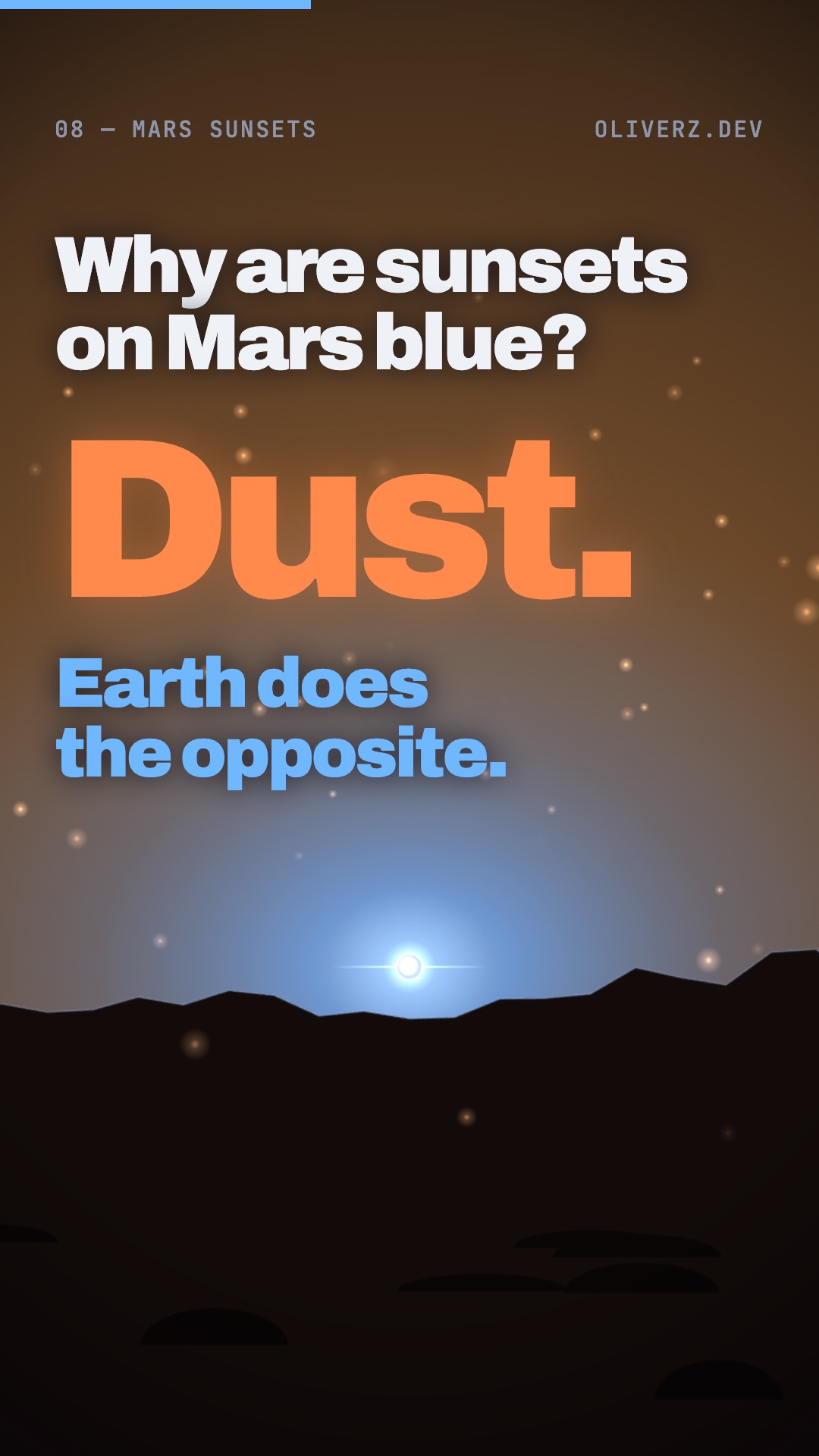
In short: on Mars the sky is orange or reddish by day, and as the Sun sets, the sky around it turns blue-grey. Earth does the opposite: a blue sky, a red sunset. The Sun is the same; what differs is what its light hits. Earth's air molecules are far smaller than a wave of light and scatter blue the most, all over the sky, so at sunset, through far more air, the reds and yellows get through. Mars's air carries fine dust grains bigger than a wave of light, and the blue they scatter stays close to the direction of the Sun.
On Mars, the opposite
NASA Space Place: "During the daytime, the Martian sky takes on an orange or reddish color. But as the Sun sets, the sky around the Sun begins to take on a blue-gray tone."
The best-known picture of it was taken by NASA's Curiosity rover in Gale Crater on 15 April 2015 (JPL image PIA19400, "Sunset in Mars' Gale Crater").
On Earth it's the other way round: blue by day, red at sunset. Same Sun, same sunlight.
Earth: tiny molecules throw blue everywhere
NOAA's National Weather Service in Flagstaff: "While all colors are scattered by air molecules, violet and blue are scattered most." NASA Space Place gives the reason: "Blue light is scattered more than the other colors because it travels as shorter, smaller waves."
So the blue gets thrown all over the sky, and the sky looks blue.
How much more: about 5×
Lord Rayleigh worked it out in 1871 (then the Hon. J. W. Strutt, "On the light from the sky, its polarization and colour", Philosophical Magazine). As the Physics FAQ at UC Riverside puts it: "He showed that the amount of light scattered is inversely proportional to the fourth power of wavelength for sufficiently small particles."
Blue light is about 470 nm (HyperPhysics), and red light, the longest wavelengths, about 700 nm (NASA Science). Our arithmetic: (700 ÷ 470)⁴ ≈ 4.9, so blue is scattered about 5× as much as red.
Why not a violet sky, then? NOAA: "The sky looks blue, not violet, because our eyes are more sensitive to blue light (and the sun also emits more energy as blue light than as violet)."
Earth's sunset: about 38× the air
At sunset, the light's path is much longer. NASA Space Place: "As the Sun gets lower in the sky, its light is passing through more of the atmosphere to reach you. Even more of the blue light is scattered, allowing the reds and yellows to pass straight through to your eyes."
How much longer? Kasten and Young's 1989 formula (Applied Optics), as quoted on Wikipedia's "Air mass (astronomy)", gives "an air mass of approximately 38 at the horizon": about 38 times the air the light crosses with the Sun overhead.
Mars: dust bigger than a wave of light
Mars's air is full of dust. From Mars Pathfinder's images, Tomasko and colleagues (JGR Planets, 1999) found: "The geometric cross‐section‐weighted mean particle radius is 1.6 ± 0.15 μm". That makes a grain about 3 µm across, against blue light's 0.47 µm (our arithmetic): bigger than a wave of light.
Red spreads out, blue stays near the Sun
Mark Lemmon of Texas A&M, on the Curiosity team, explained the colours to NASA/JPL in 2015: "The colors come from the fact that the very fine dust is the right size so that blue light penetrates the atmosphere slightly more efficiently,"
And: "When the blue light scatters off the dust, it stays closer to the direction of the sun than light of other colors does. The rest of the sky is yellow to orange, as yellow and red light scatter all over the sky instead of being absorbed or staying close to the sun."
So the glow around the setting Sun is blue
JPL's caption for PIA19400: "Dust in the Martian atmosphere has fine particles that permit blue light to penetrate the atmosphere more efficiently than longer-wavelength colors."
Not the whole Martian sky: by NASA's description, it's the sky around the setting Sun that turns blue-grey.
Takeaway
Four skies: Earth blue by day and red at sunset, Mars orange-red by day and blue around the setting Sun. The colour isn't set by the Sun; it's set by what's in the air.
Sources
- NASA Space Place, Why Is the Sky Blue?, updated 29 Aug 2022
- NOAA National Weather Service, Flagstaff, Why is the sky blue?
- Philip Gibbs, Why is the sky blue?, Physics FAQ, UC Riverside, 1997
- HyperPhysics (Georgia State University), Color
- NASA Science, Visible Light
- J. W. Strutt, On the light from the sky, its polarization and colour, Philosophical Magazine 41, Feb 1871
- Wikipedia, Air mass (astronomy), for Kasten & Young, Applied Optics 28(22), 1989
- NASA/JPL, NASA's Curiosity Rover Views Serene Sundown on Mars, 8 May 2015
- NASA/JPL, PIA19400: Sunset in Mars' Gale Crater, 8 May 2015
- Tomasko et al., Properties of dust in the Martian atmosphere from the Imager on Mars Pathfinder, JGR Planets, 1999
The video is animated with code and the script was written with AI assistance; every figure above is checked against the sources, and the two calculations are ours. Illustrative: every sky, beam, dust grain and molecule is drawn, not photographed, and the scattering is shown, not simulated. Made with Shotloop, my free Mac app for code-made explainers, fixed one shot at a time.