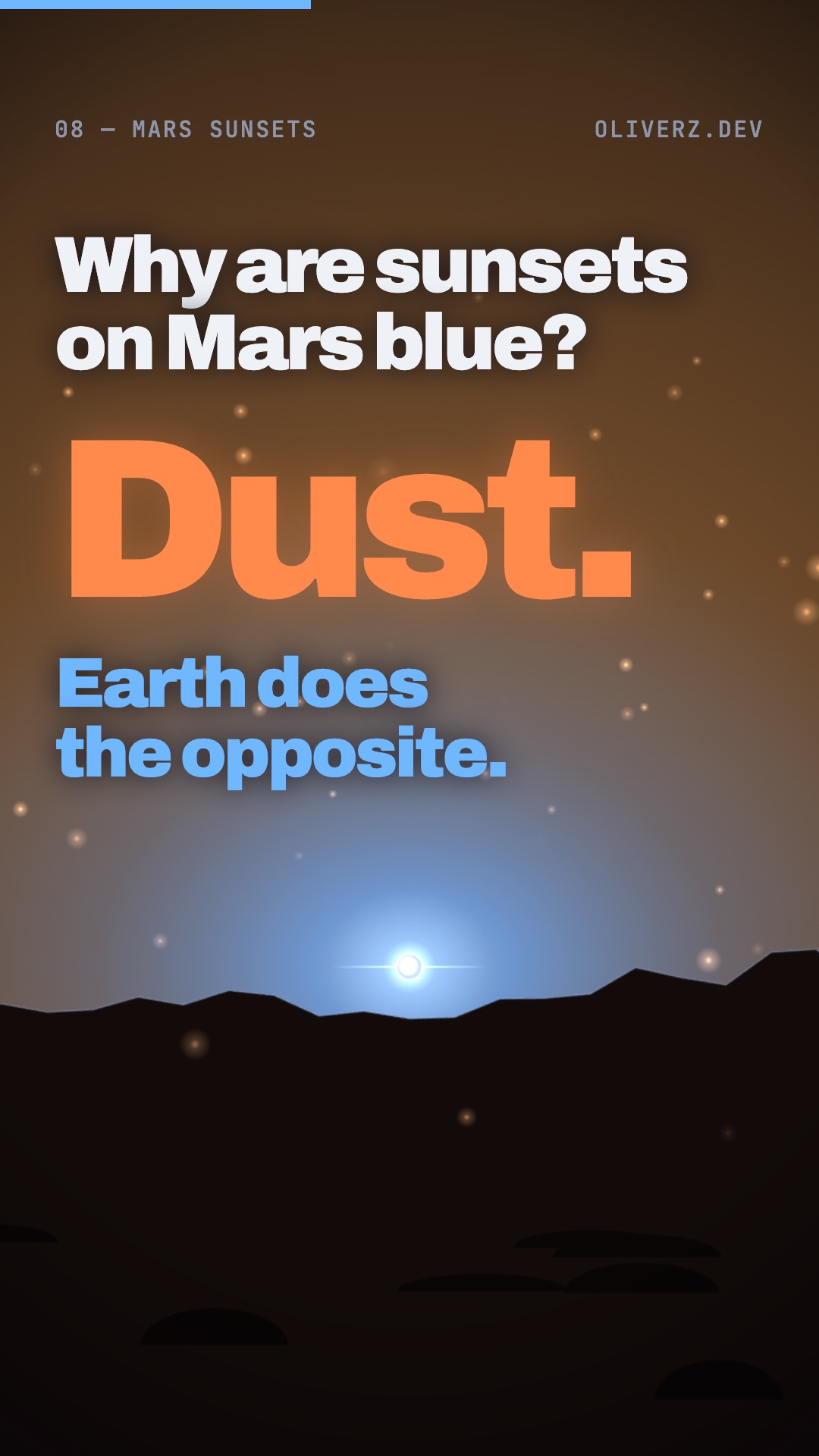
一句話總結: 火星的天空白天是橙色或偏紅的,太陽西下時,它周圍的天空會變成藍灰色。地球正好相反:天空是藍的,日落是紅的。太陽是同一個;不同的是它的光碰到了什麼。地球的空氣分子比光波小得多,對藍光的散射最強,把藍光散滿整片天空,所以到了日落,光要穿過多得多的空氣,紅色和黃色就透了過來。火星的空氣裡帶著比光波還大的細小塵埃顆粒,它們散射的藍光留在靠近太陽的方向。
火星上,正好相反
NASA Space Place:「During the daytime, the Martian sky takes on an orange or reddish color. But as the Sun sets, the sky around the Sun begins to take on a blue-gray tone.」(白天,火星的天空呈橙色或偏紅色。但隨著太陽西下,太陽周圍的天空開始呈現藍灰色調。)
最有名的照片是 NASA 的好奇號(Curiosity)火星車於 2015 年 4 月 15 日在蓋爾撞擊坑拍下的(JPL 影像 PIA19400,「Sunset in Mars' Gale Crater」)。
地球上則反過來:白天是藍的,日落是紅的。同一個太陽,同樣的陽光。
地球:極小的分子把藍光拋向四面八方
美國國家海洋暨大氣總署(NOAA)國家氣象局弗拉格斯塔夫辦公室:「While all colors are scattered by air molecules, violet and blue are scattered most.」(雖然所有顏色都會被空氣分子散射,但紫光和藍光被散射得最多。)NASA Space Place 給出了原因:「Blue light is scattered more than the other colors because it travels as shorter, smaller waves.」(藍光比其他顏色散射得更多,因為它以更短、更小的波傳播。)
所以藍光被拋滿整片天空,天空看起來就是藍的。
多多少:約 5 倍
瑞利勳爵(Lord Rayleigh)在 1871 年算出了這一點(當時他還叫 J. W. Strutt 閣下,論文為〈On the light from the sky, its polarization and colour〉,發表於《哲學雜誌》)。正如加州大學河濱分校的 Physics FAQ 所說:「He showed that the amount of light scattered is inversely proportional to the fourth power of wavelength for sufficiently small particles.」(他證明,對於夠小的粒子,散射光的量與波長的四次方成反比。)
藍光約為 470 nm(HyperPhysics),紅光是波長最長的光,約為 700 nm(NASA Science)。我們自己算的:(700 ÷ 470)⁴ ≈ 4.9,所以藍光被散射的量約為紅光的 5 倍。
那為什麼天空不是紫色的?NOAA:「The sky looks blue, not violet, because our eyes are more sensitive to blue light (and the sun also emits more energy as blue light than as violet).」(天空看起來是藍色而不是紫色,因為我們的眼睛對藍光比較敏感(而且太陽以藍光形式發出的能量也比紫光多)。)
地球的日落:約 38 倍的空氣
日落時,光走的路徑長得多。NASA Space Place:「As the Sun gets lower in the sky, its light is passing through more of the atmosphere to reach you. Even more of the blue light is scattered, allowing the reds and yellows to pass straight through to your eyes.」(太陽在天空中越低,它的光要穿過越多的大氣才能到達你。更多的藍光被散射掉,紅色和黃色就能直接穿過來,進入你的眼睛。)
長多少?Kasten 和 Young 1989 年的公式(《應用光學》),依維基百科「Air mass (astronomy)」條目的引述,給出了「an air mass of approximately 38 at the horizon」(地平線處的大氣質量約為 38):也就是說,光要穿過的空氣約為太陽在頭頂時的 38 倍。
火星:比光波還大的塵埃
火星的空氣裡滿是塵埃。根據火星拓荒者號(Mars Pathfinder)拍攝的影像,Tomasko 等人(《地球物理研究期刊:行星》,1999 年)發現:「The geometric cross‐section‐weighted mean particle radius is 1.6 ± 0.15 μm」(按幾何截面加權的平均粒子半徑為 1.6 ± 0.15 μm)。也就是說,一顆塵埃的直徑約 3 µm,而藍光是 0.47 µm(我們自己算的):比光波還大。
紅光散開,藍光留在太陽附近
德州農工大學的 Mark Lemmon 是好奇號團隊的成員,2015 年他向 NASA/JPL 解釋了這些顏色:「The colors come from the fact that the very fine dust is the right size so that blue light penetrates the atmosphere slightly more efficiently,」(這些顏色來自這樣一個事實:非常細的塵埃大小剛好,讓藍光穿透大氣的效率稍微高一些,)
還有:「When the blue light scatters off the dust, it stays closer to the direction of the sun than light of other colors does. The rest of the sky is yellow to orange, as yellow and red light scatter all over the sky instead of being absorbed or staying close to the sun.」(藍光被塵埃散射時,會比其他顏色的光更靠近太陽的方向。天空的其餘部分呈黃色到橙色,因為黃光和紅光會散射到整片天空,而不是被吸收或留在太陽附近。)
所以落日周圍的光暈是藍色的
JPL 對 PIA19400 的說明:「Dust in the Martian atmosphere has fine particles that permit blue light to penetrate the atmosphere more efficiently than longer-wavelength colors.」(火星大氣中的塵埃含有細小顆粒,讓藍光比波長更長的顏色更有效率地穿透大氣。)
並不是整片火星天空:依 NASA 的描述,變成藍灰色的是落日周圍的天空。
結論
四種天空:地球白天藍、日落紅;火星白天橙紅、落日周圍泛藍。顏色不是由太陽決定的,而是由空氣裡有什麼決定的。
來源
- NASA Space Place,Why Is the Sky Blue?,2022 年 8 月 29 日更新
- NOAA 國家氣象局弗拉格斯塔夫辦公室,Why is the sky blue?
- Philip Gibbs,Why is the sky blue?,Physics FAQ,加州大學河濱分校,1997
- HyperPhysics(喬治亞州立大學),Color
- NASA Science,Visible Light
- J. W. Strutt,On the light from the sky, its polarization and colour,Philosophical Magazine 41,1871 年 2 月
- 維基百科,Air mass (astronomy),引用 Kasten & Young,Applied Optics 28(22),1989
- NASA/JPL,NASA's Curiosity Rover Views Serene Sundown on Mars,2015 年 5 月 8 日
- NASA/JPL,PIA19400: Sunset in Mars' Gale Crater,2015 年 5 月 8 日
- Tomasko 等,Properties of dust in the Martian atmosphere from the Imager on Mars Pathfinder,JGR Planets,1999
影片以程式碼製作動畫,腳本在 AI 協助下撰寫;上面每個數字都對照來源查證過,兩處計算是我們自己算的。示意的部分:每一片天空、每一道光、每一顆塵埃和分子都是畫出來的,不是拍出來的;散射是示範,不是模擬。影片為英文。影片用 Shotloop 製作:我做的免費 Mac 應用程式,用程式碼做科普短片,一個鏡頭一個鏡頭地修改。