Contents
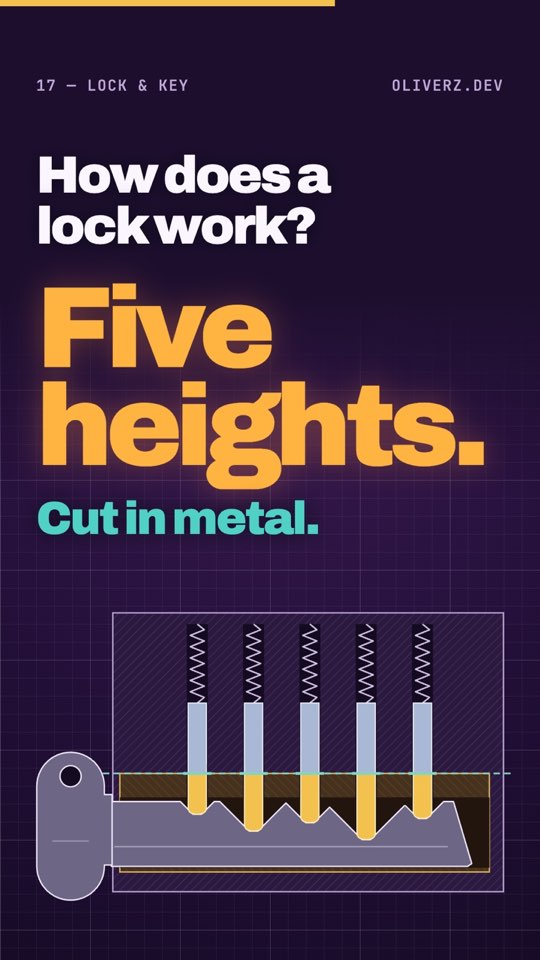
In short: in a pin-tumbler lock, a plug sits inside a housing, and to open, the plug must turn. Five or so stacks of pins cross the line between them, the shear line: a key pin, a driver pin and a spring. With no key, the springs push the driver pins across the line and the plug is jammed. A key's cuts lift each stack to its own height, and only the right key puts every split between key pin and driver pin exactly on the line. One cut too deep or too shallow and a pin still blocks it. Five pins with ten depths make up to 100,000 keys in theory; a master key works because a spacer pin gives a stack a second split.
A plug that must turn
Wikipedia, on the pin tumbler lock: "In this type of lock, an outer casing has a cylindrical hole in which the plug is housed. To open the lock, the plug must rotate." Lockwiki: "The plug is the inner piece of the lock that rotates upon insertion and tension of the correct key."
The Engineering Mindset names the line between them: "The intersection between the plug and the lock housing is known as the shear line."
Pins across the shear line
Holes are drilled through both. Wikipedia: "A series of holes, typically five or six of them, are drilled vertically into the plug." (Our drawing has five.) In them: "key pins of various lengths, which are rounded to permit the key to slide over them easily", and "Above each key pin is one or more spring-loaded driver pins." The Engineering Mindset: "Within each chamber we find a spring which pushes another pin, known as a driver pin."
No key: jammed
Wikipedia: "When the plug and outer casing are assembled, the pins are pushed down into the plug by the springs." And: "When the key is not in the lock, the pins straddle the shear point, preventing the plug from rotating."
The Engineering Mindset: "With no key inserted, the driver pins sit part way in the housing chamber and part way within the plug. This means the plug is unable to rotate."
Each cut, its own height
A key is a row of heights. The Engineering Mindset: "Each key pin is a different height, and this will correspond to the profile of the key." Lockwiki: "Key pins are sized differently corresponding to the different depth cuts on the key." Those depths are the key's bitting, "the depth of key cuts on a cylinder key for a pin tumbler lock, often expressed as a number" (Wikipedia). Our example key is cut 2-6-4-8-3.
The right key: every split on the line
Wikipedia: "With a key properly cut and inserted into the groove on the end of the plug, the pins will rise causing them to align exactly at the shear point. This allows the plug to rotate, thus opening the lock." Lockwiki: "Each pin stack must be properly aligned to allow pins to separate at the shear line. Once all pin stacks are properly aligned the plug can freely rotate and actuate the locking bolt to lock or unlock the lock."
As it turns, the pins part at the line. The Engineering Mindset: "The driver pins will have been pushed up and will now fully sit within the housing while the key pins sits fully within the plug. This means the plug is now able to rotate."
One cut off: blocked
Wikipedia: "If the wrong key is used, the pins remain misaligned, preventing the plug from turning". A cut too deep leaves a driver pin across the line; a cut too shallow pushes a key pin across it. The design that blocks both is old: Wikipedia's history calls the double-acting pin tumbler "one where lifting the pins too much or too little prevented opening". Lockwiki: "An incorrect key will not align all components correctly; rotation of the plug will be blocked at the shear-line."
Up to 100,000 keys, in theory
Lockwiki: "Theoretically, most locks have a very high number of differs but in reality tolerances and bitting restrictions lower this number dramatically. For example, a 5 pin lock with 10 depth spacings has 10⁵ (100,000) theoretical key differs." That is 10 × 10 × 10 × 10 × 10. Fewer in practice, as Lockwiki says; we don't put a number on how many.
A master key: a second split
Wikipedia: "In a master-keyed lock, some or all of the pin chambers in the lock have three pins in them instead of two. Between the driver pin and the key pin is a third pin called the spacer pin, also known as a master wafer. Thus each pin line has two shear points." And: "So the lock will open with two keys; one aligns the first set of shear points and the other aligns the second set of shear points."
That's how a building works: "Each tenant is given a key that only unlocks their own door, called the change key, but the second key is the master key, which unlocks all the doors."
Takeaway
- The plug turns only when every pin stack splits exactly at the shear line; with no key, springs push the drivers across it.
- Your key is a row of heights: its cuts lift each stack by a different amount, and one cut off by a step leaves a pin in the way.
- Five pins with ten depths allow up to 100,000 keys in theory; a master key works because a spacer pin gives each stack a second split.
Sources
- Wikipedia: Pin tumbler lock, Master key, Bitting (key)
- The Engineering Mindset, P. Evans, How Padlocks Work (2020)
- Lockwiki: Pin-tumbler, Differs
The video is animated with code and the script was written with AI assistance; every quote above is checked against its source. Illustrative: the lock and key drawings (proportions, five stacks, pin lengths, the keyway, the end view), the bitting 2-6-4-8-3 and its ten even depth steps, the wrong keys, the master-keyed stack's lengths, and the crowd of keys. It explains the mechanism only, nothing about opening a lock without its key. The video is narrated in English. Made with Shotloop, my free Mac app for code-made explainers, fixed one shot at a time.