Contents
- In a turn, the outer wheel goes farther
- On one solid axle, a tire slips
- Pinion, ring gear, carrier
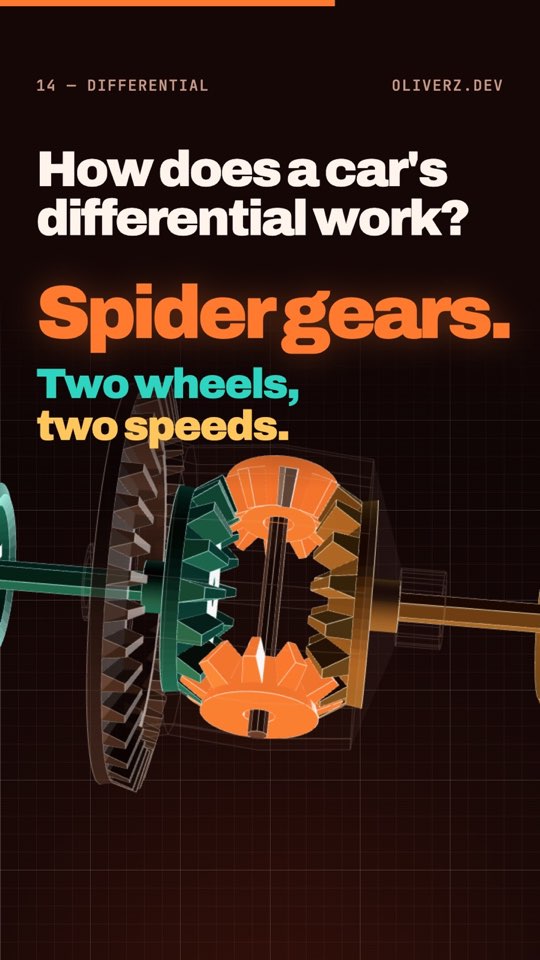
- Spider gears on a pin
- Going straight: one block
- In a turn: the spider gears spin
- Why: one side gains what the other loses
- The ring gear turns at the average
- Both wheels still driven
- Explained in 1937
- Takeaway
- Sources
In short: in a corner the outer wheel travels farther than the inner one, so two driven wheels must turn at different speeds; on one solid axle a tire would have to slip. The differential lets them: the driveshaft's pinion turns a ring gear, the ring gear turns a carrier, and inside it spider gears on a pin mesh with a side gear for each wheel. Going straight it all turns as one block. In a turn the spider gears spin on their pin, taking from the inner side exactly what they add to the outer, so the ring gear always turns at the average and both wheels stay driven.
In a turn, the outer wheel goes farther
Wikipedia: "During cornering, the outer wheels of a vehicle must travel farther than the inner wheels (since they are on a larger radius)." Quadratec puts it in terms of speed: "Whenever a vehicle negotiates a turn, the outside wheel must travel farther (turn faster) than the inside wheel." And The Drive: "The outside wheel is spinning faster as it has a slightly longer path to take than the inside wheel."
The video's turn is illustrative (our arithmetic): a 90° corner, the inner rear wheel on a 5 m radius and a 1.6 m track, so the outer one on 6.6 m. The inner wheel covers π/2 × 5 ≈ 7.9 m, the outer π/2 × 6.6 ≈ 10.4 m.
On one solid axle, a tire slips
Lesics: "If these wheels were connected using a solid shaft, the wheels would have to slip to accomplish the turn."
Pinion, ring gear, carrier
Wikipedia: "a ring gear is driven by a pinion gear connected to the transmission." And: "Input torque is applied to the ring gear (purple), which rotates the carrier (purple) at the same speed."
The Drive follows the same path from the other end: "The spinning motion of the driveshaft makes its way to the input pinion inside the differential housing. This turns a ring gear that the differential itself is attached to, which then, through a series of gears, turns the rear driveshafts."
Spider gears on a pin
Quadratec: "The ring gear is bolted to one side, and the spider gears, or differential gears, are housed internally." And: "Differential Pin: This pin keeps the spiders gears aligned".
Lesics: "The spider gear is meshed with 2 side gears." There is one side gear for each wheel.
Going straight: one block
Quadratec: "When the vehicle is driven in a straight line, an equal force is placed on both side gears. Due to this, the spider gears will not rotate."
Lesics: "In short, when the vehicle moves straight, the spider-side gear assembly will move as a single solid unit." Wikipedia adds that the spider (its "planet gear") still goes round with the carrier: "the planet gear (green) doesn't rotate on its axis (although the gear and its pin are orbiting due to being attached to the carrier)."
Both wheels turn at the ring gear's speed.
In a turn: the spider gears spin
Quadratec: "This is accomplished by a series of gears that allow the outside wheel to turn faster than the ring gear, while the inside wheel turns slower than the ring gear."
RANDYS: going straight "the spider gears remain motionless within the carrier", and "When the spider gears are in motion they rotate on the cross-pin shaft, especially when the vehicle is turning a corner."
Why: one side gains what the other loses
Lesics: "When the spider gear is spinning as well as rotating, peripheral velocity on the left side of spider gear is the sum of the spinning and rotational velocities. But on the right side, it is the difference of the two, since the spin velocity is in the opposite direction on this side."
The ring gear turns at the average
Wikipedia: "A differential is a gear train with three drive shafts that has the property that the rotational speed of one shaft is the average of the speeds of the others."
In the video's turn (our arithmetic): wheel speed goes with the radius, and the carrier sits at the average radius, 5.8 m. The inner wheel turns at 5 ÷ 5.8 ≈ 86% of the ring gear's speed, the outer at 6.6 ÷ 5.8 ≈ 114%, and (86 + 114) ÷ 2 = 100.
Both wheels still driven
The Drive: "A differential takes power coming from the engine through the drivetrain and splits it up between the wheels that it's assigned to control." Lesics gives the differential's job as "to allow the drive wheels to turn at different rpms while both receiving power from the engine."
Explained in 1937
A 1937 film explained all this, and The Drive (2020) writes: "Despite it being 83 years old, it still holds up as one of the best explanations videos to understand what goes on inside a differential".
Takeaway
- In a turn the two driven wheels must turn at different speeds: the outer one has farther to go.
- The differential's spider gears allow it: going straight they just ride along (one block); in a turn they spin on their pin.
- Their spin takes from the inner wheel exactly what it gives the outer one, so the ring gear turns at the average and both wheels stay driven.
Sources
- Wikipedia, Differential (mechanical device), revision of 17 September 2026
- Quadratec, Differentials Explained - Standard Open Differential
- S. Mathew, Lesics, How does a differential work?, 7 May 2014
- RANDYS Worldwide, How It Works: Spider Gears, 19 November 2025
- P. Nelson, The Drive, Demystifying the Differential, a Crucial Drivetrain Component, 28 April 2022
- J. Garcia, The Drive, This Incredible Film From 1937 Teaches You How a Car's Differential Works, 1 August 2020
The video is animated with code and the script was written with AI assistance; every quote above is checked against its source, and the figures marked "our arithmetic" are ours. Illustrative: the car, the 90° turn and the speeds that follow from it, and the drawings of the differential (its tooth counts, ring-to-pinion ratio and proportions are not any real car's). The video is narrated in English. Made with Shotloop, my free Mac app for code-made explainers, fixed one shot at a time.