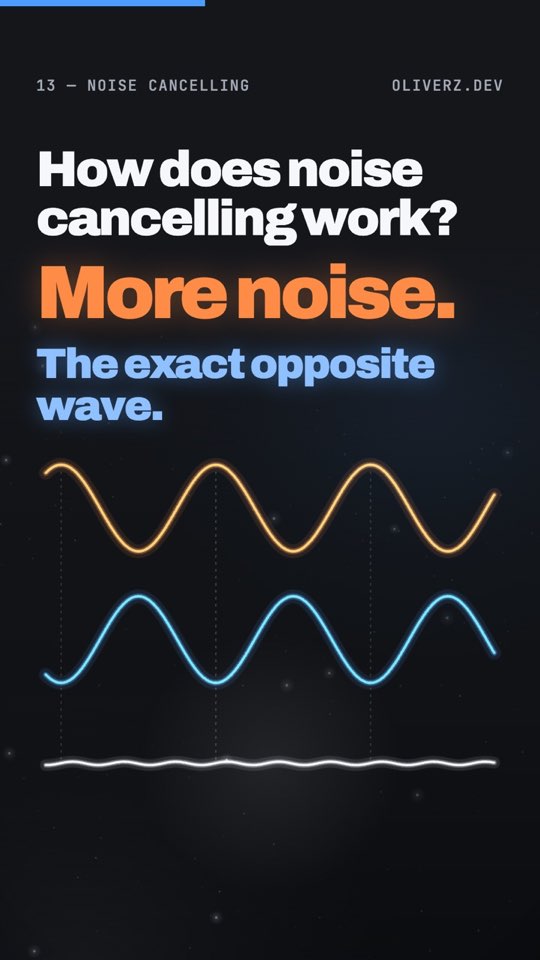
一句話總結: 降噪耳機並不擋住噪音,而是再加上更多的聲音。聲音是一道高低起伏的壓力波;加上和它正好相反的波,在它高的地方變低,兩者就會互相抵消,幾乎歸於安靜。耳罩外的麥克風先聽到噪音,晶片把它上下翻轉,喇叭播放這道鏡像波,這一切都要在噪音本身抵達耳朵之前的幾十微秒內完成。耳罩內的第二個麥克風檢查還剩下什麼,並加以修正。正是這場賽跑,讓降噪對持續的低沉嗡嗡聲效果最好,對人聲和突然的聲音則差得多,這些只能靠耳墊去擋。
用聲音對抗聲音
BBC Science Focus:「Noise-cancelling headphones cancel out unwanted sound by creating an opposing sound wave that mimics the noise you want to get rid of, but just 180° out of phase. This means that when one sound wave is at its highest peak, the other is at its lowest, effectively cancelling each other out. This is known as 'destructive interference'.」(降噪耳機消除不想要的聲音的方法,是製造一道模仿你想去掉的噪音的反向聲波,只是相位相差 180°。也就是說,一道聲波在最高峰時,另一道正在最低谷,兩者實際上互相抵消。這叫作「破壞性干涉」。)
高壓遇上低壓
The Physics Classroom:「Sound is a pressure wave that consists of compressions and rarefactions.」(聲音是一種由壓縮和稀疏組成的壓力波。)壓縮是「a high-pressure region」(高壓區),稀疏是「a low-pressure region」(低壓區)。當兩者正好對上時:「The tendency of the compression to push particles together is canceled by the tendency of the rarefactions to pull particles apart; the particles would remain at their rest position as though there wasn't even a disturbance passing through them.」(壓縮把粒子擠在一起的趨勢,被稀疏把粒子拉開的趨勢抵消了;粒子會停在靜止位置,就好像根本沒有擾動經過它們。)於是「two sound waves would combine to produce no sound.」(兩道聲波合在一起,就不會產生聲音。)
聽到它,翻轉它,播放它
還是 The Physics Classroom:「Such earphones capture sound from the environment and use computer technology to produce a second sound wave that one-half cycle out of phase.」(這種耳機擷取環境中的聲音,再用電腦技術產生第二道相差半個週期的聲波。)
BBC Science Focus 講到其中的零件:「First, there is a microphone on the earcup to listen out for annoying external sound.」(首先,耳罩上有一個麥克風,用來收聽惱人的外部聲音。)接著「the 'out-of-phase' sound is created and then fed into the headphone speakers, along with the music you're playing.」(產生「反相」的聲音,再和你正在播放的音樂一起送進耳機的喇叭。)
幾十微秒的賽跑
IEEE Spectrum(2018):「having microphones located so close to the ears means commercial headphones get just tens of microseconds to process incoming sound, calculate an antinoise signal, and play it through their speakers before the sound reaches the ears.」(麥克風離耳朵這麼近,意味著市售耳機只有短短幾十微秒,要在聲音抵達耳朵之前處理傳入的聲音、算出反噪音訊號,並透過喇叭播放出來。)
在 20 °C 的空氣中,聲速是「v = 343 m/s」(The Physics Classroom)。以示意的 2 公分來算,噪音穿過耳罩大約需要 58 微秒(我們自己算的:2 cm ÷ 343 m/s;沒有任何來源給出耳罩的深度)。
第二個麥克風檢查剩下的部分
SoundGuys:「With feedforward technology, the noise-capturing microphones are placed on the outside of the headphones.」(採用前饋技術時,擷取噪音的麥克風放在耳機外側。)以及:「With feedback ANC, the microphone is located inside the ear cup」(採用回授式 ANC 時,麥克風位於耳罩內部),所以「You can think of feedback ANC as a self-correcting mechanism.」(你可以把回授式 ANC 看作一種自我校正機制。)混合式 ANC 則「combines both feedforward and feedback microphones and processing」(結合了前饋和回授兩種麥克風及其處理)。
對持續的嗡嗡聲最有效
時限也就是極限。IEEE Spectrum:「Such a tight computing deadline limits the performance of most active noise-cancellation technology, setting an upper limit on the frequencies it can actively cancel. This requires many headphones to shield the wearer's ears with sound-absorbing materials for higher frequencies.」(如此緊迫的運算時限限制了大多數主動降噪技術的表現,替它能主動消除的頻率設了上限。因此,許多耳機需要用吸音材料替配戴者的耳朵擋住較高的頻率。)在它 2018 年的報導中,一款高階耳機的「active noise-canceling range of 0 to 1 kHz」(主動降噪範圍為 0 到 1 kHz),並依靠「passive soundproofing material to dampen sounds in the 1- to 4-kHz range」(被動隔音材料來減弱 1 到 4 kHz 範圍的聲音)。
SoundGuys:「Active Noise Cancellation (ANC) systems work best on droning sounds that are constant in frequency and intensity. Because quick, irregular sounds like music sounds and people talking are over with long before your headset can calculate how to cancel them, the only noise attenuation your ANC headset will offer against annoying coworkers/TV noise is simply what sound they can physically block out.」(主動降噪(ANC)系統對頻率和強度都恆定的嗡嗡聲效果最好。由於短促、不規則的聲音,像是音樂聲和人說話,在耳機算出如何抵消它們之前早就結束了,所以面對惱人的同事或電視噪音,ANC 耳機能提供的降噪,只是它們在物理上能擋住的那部分聲音。)
BBC Science Focus:「It works best with lower frequencies, like transport noise」(它對較低的頻率效果最好,例如交通工具的噪音)。
接近安靜,而不是完全安靜
SoundGuys:「you won't ever see 100% cancellation」(你永遠看不到 100% 的消除)。BBC Science Focus:「while it can't erase unwanted sound entirely」(雖然它無法完全抹去不想要的聲音)。
結論
- 降噪是用聲音對抗聲音:相反的聲波相加,幾乎歸於安靜。
- 這是一場賽跑:在噪音穿過耳罩之前的幾十微秒內,聽到、翻轉、播放;耳罩內的麥克風再修正剩下的部分。
- 所以它對持續的嗡嗡聲很有效,對人聲和突然的聲音則較弱:這些要靠配戴的貼合度和耳墊。
來源
- BBC Science Focus,How do noise-cancelling headphones cancel sounds?,2020 年 10 月 18 日
- J. Hsu,IEEE Spectrum,New Wireless Noise-Canceling Tech Is Faster Than the Speed of Sound,2018 年 9 月 5 日
- C. Thomas,SoundGuys,Active noise canceling (ANC) technology types explained,2025 年 10 月 16 日更新
- The Physics Classroom:Interference and Beats、The Speed of Sound
影片以程式碼製作動畫,腳本在 AI 協助下撰寫;上面每段引文都對照出處查證過,標註「我們自己算的」的 58 微秒是我們自己的計算,基於示意的 2 公分。示意的部分:波形、耳罩的剖面圖和其中的零件、2 公分,以及耳機。0–1 kHz 和 1–4 kHz 這兩個範圍來自 2018 年報導的一款高階耳機(IEEE Spectrum),並非所有耳機。影片為英文旁白。影片用 Shotloop 製作:我做的免費 Mac 應用程式,用程式碼做科普短片,一個鏡頭一個鏡頭地修改。