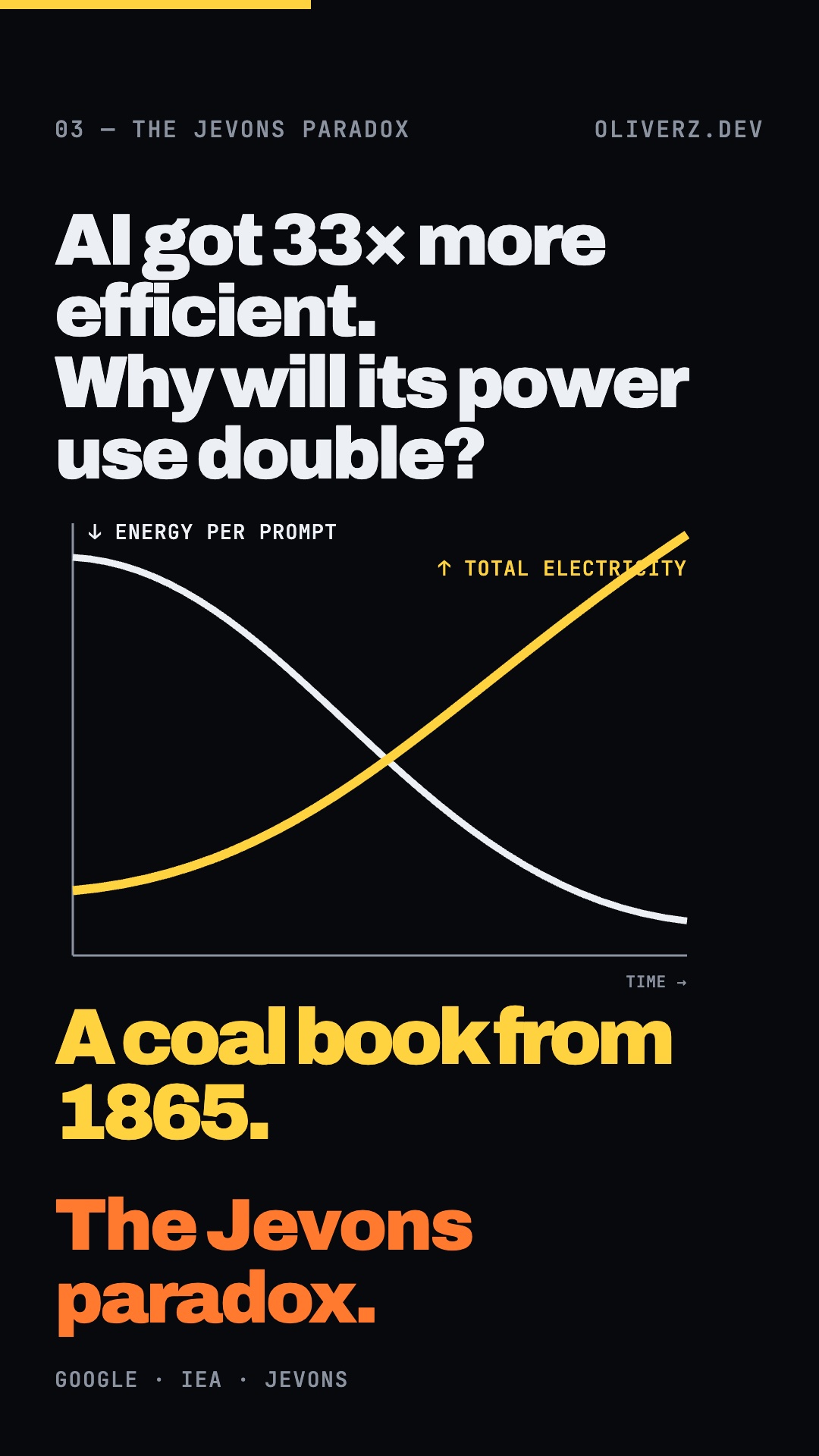
一句話總結: 就每則提示詞而言,AI 確實變得高效許多:Google 說,Gemini 文字提示詞的中位數能耗在 12 個月內降低了 33 倍。然而到 2030 年,資料中心的用電量預計將成長一倍以上,國際能源總署(IEA)認為 AI 是主要推力。這個規律有名字,也有一個 160 年前的例證。1860 年代,蘇格蘭的煉鐵爐把每噸鐵的耗煤量降到原來的三分之一以下,蘇格蘭燒掉的煤卻變成原來的十倍。W. S. Jevons(傑文斯)在 1865 年把這件事寫了下來,如今它被稱為傑文斯悖論。「更高效」回答不了能源問題,用量才能回答。
每則提示詞的能耗低了 33 倍
2025 年 8 月,Google 公布了它的 Gemini 助理回答問題要消耗多少能源。最醒目的一句是:「over a recent 12 month period, the energy and total carbon footprint of the median Gemini Apps text prompt dropped by 33x and 44x, respectively, all while delivering higher quality responses」(在最近 12 個月內,Gemini 應用程式文字提示詞的中位數能耗與總碳足跡分別降低了 33 倍和 44 倍,同時回答品質更高)。
以絕對值計算,Google 估計「the median Gemini Apps text prompt uses 0.24 watt-hours (Wh) of energy」(Gemini 應用程式文字提示詞的中位數能耗為 0.24 瓦時(Wh))。它自己的比喻是:「The per-prompt energy impact is equivalent to watching TV for less than nine seconds.」(每則提示詞的能耗,相當於看不到九秒鐘的電視。)
這個數字說的是一家公司的一個模型 Gemini,以及它的中位數文字提示詞,並不代表整個「AI」。
但總量預計要翻倍
再看另一個數字。國際能源總署(IEA)說:「Data centres accounted for around 1.5% of the world's electricity consumption in 2024, or 415 terawatt-hours (TWh).」(2024 年,資料中心約占全球用電量的 1.5%,即 415 太瓦時(TWh)。)
而且它預期這個數字還會成長:「Data centre electricity consumption is set to more than double to around 945 TWh by 2030. This is slightly more than Japan's total electricity consumption today. AI is the most important driver of this growth, alongside growing demand for other digital services.」(到 2030 年,資料中心用電量預計將成長一倍以上,達到約 945 TWh,略高於日本目前的總用電量。AI 是這波成長最重要的推力,其他數位服務的需求成長也在推動。)
所以:每次使用少了很多,總量卻多了很多。只要記得總量等於每則提示詞的能耗 × 提示詞的數量,這就不矛盾了,而爆炸性成長的是第二個數字。
以前發生過,在煤炭上
1865 年,W. S. Jevons 出版了 The Coal Question(《煤炭問題》)。他在書中提出一個聽起來正好相反的論點:「It is wholly a confusion of ideas to suppose that the economical use of fuel is equivalent to a diminished consumption. The very contrary is the truth.」(認為節約使用燃料就等於減少消耗,完全是觀念混淆。事實恰恰相反。)
他的證據是蘇格蘭的煉鐵業。那裡的煉鐵爐變得高效許多,然而:「the reduction of the consumption of coal, per ton of iron, to less than one-third of its former amount, has been followed, in Scotland, by a ten-fold total consumption」(每噸鐵的耗煤量降到原來的三分之一以下之後,蘇格蘭的煤炭總消耗量隨之成長到十倍)。
每噸的煤不到原來的三分之一,煤的總量卻是原來的十倍。用他的話說,「the greater number of furnaces will more than make up for the diminished consumption of each」(煉鐵爐數量的增加,會遠遠抵銷每座爐子消耗的減少)。
他的解釋是,正是節約本身推高了用量:「It is the very economy of its use which leads to its extensive consumption. It has been so in the past, and it will be so in the future.」(正是使用上的節約,導致了它的大量消耗。過去如此,將來也會如此。)
傑文斯悖論
這個觀點如今以他的名字命名。耶魯大學的能源史計畫寫道:「His insight, often called Jevons' Paradox, is today used to explain why increased energy efficiency does not necessarily reduce present-day demand for electricity or gasoline.」(他的這項洞見常被稱為傑文斯悖論,如今被用來解釋為什麼能源效率提高,不一定會減少當今對電力或汽油的需求。)
套用到 AI:提示詞更便宜,就代表更多的提示詞。而用量已經非常龐大。TechCrunch 在 2025 年 7 月報導:「ChatGPT receives 2.5 billion prompts from global users every day, OpenAI told Axios」(OpenAI 告訴 Axios,ChatGPT 每天收到全球使用者的 25 億則提示詞)。這還只是一款產品。
微軟執行長就用它來談 AI。據《財星》引述,2025 年 1 月,Satya Nadella(薩蒂亞・納德拉)寫道:「Jevons paradox strikes again! As AI gets more efficient and accessible, we will see its use skyrocket, turning it into a commodity we just can't get enough of.」(傑文斯悖論又來了!隨著 AI 越來越高效、越來越容易取得,它的使用量會飆升,變成一種我們怎麼用都不夠的大宗商品。)
研究者也注意到了。Luccioni、Strubell 和 Crawford 在 2025 年的一篇論文中「examines how the problem of Jevons' Paradox applies to AI, whereby efficiency gains may paradoxically spur increased consumption」(探討傑文斯悖論這個問題如何適用於 AI:效率的提升可能反而刺激消耗增加)。
需要謹慎說明:以上沒有任何一項說 Gemini 的 33 倍導致了用電量翻倍。傑文斯悖論是這些來源用來解釋「效率提高與總量上升為何同時出現」的機制,不是對這件事本身的測量。
比較一下規模
資料中心並不是全球用電的全部。還是 IEA:「Data centres account for around one-tenth of global electricity demand growth to 2030, less than the share from industrial motors, air conditioning in homes and offices, or electric vehicles.」(到 2030 年,資料中心約占全球電力需求成長的十分之一,低於工業馬達、住家與辦公室空調或電動車各自所占的比例。)
總結
- 就每則提示詞而言,AI 確實變得高效許多(Gemini:一年降低了 33 倍)。
- 總用量仍在攀升,因為用起來更便宜,就會用得多得多。傑文斯在 1865 年就從煤炭上看到了這一點。
- 所以「更高效」回答不了能源問題,用量才能回答。(而且資料中心仍只占全球需求成長的十分之一左右。)
來源
- Google Cloud(Amin Vahdat、Jeff Dean),Measuring the environmental impact of AI inference,2025 年 8 月 21 日
- IEA,Energy and AI,執行摘要,2025 年 4 月
- W. S. Jevons,The Coal Question,第 2 版,Macmillan,1866,第七章〈Of the Economy of Fuel〉,第 123–125 頁和第 134–135 頁
- 耶魯大學 Energy History,W. Stanley Jevons, The Coal Question (1865)
- TechCrunch,ChatGPT users send 2.5 billion prompts a day,2025 年 7 月 21 日
- Fortune,Microsoft CEO Satya Nadella on DeepSeek and the Jevons paradox,2025 年 1 月 27 日
- Luccioni、Strubell、Crawford,From Efficiency Gains to Rebound Effects: The Problem of Jevons' Paradox in AI's Polarized Environmental Debate,arXiv,2025 年 1 月
影片以程式碼製作動畫,腳本在 AI 協助下撰寫;上面每個數字都對照來源查證過。示意的部分:雙線圖(曲線只呈現走勢,不是數據;有來源的數字標在長條和計數器上)、煉鐵爐和煤塊,以及提示詞泡泡組成的網格。影片為英文。影片用 Shotloop 製作:我做的免費 Mac 應用程式,用程式碼做科普短片,一個鏡頭一個鏡頭地修改。